Posts

Showing posts matching the search for metaphor

Grammar: Term 1 Revision (Tuesday; 23/11)

Image
K: Know the Term 1 grammar topics. U: Understand Term 1 grammar topics. D: Apply the grammar topics in your tasks. As a reminder, here is the list of what is coming tomorrow for your English Exam: 1.     Paper 1 (Non-fiction)   -      Pronouns , proper nouns, relative pronouns .   -     Direct and Reported speech   -     Parenthesis   -     Biography (Composition): Please conduct a research about a famous person of your choice.  2.     Paper 2 (Fiction)   -      Personification , metaphor , and extended metaphor.   -     Quantifiers   -     Active and passive voices   -     Suffixes   -     Chapter 4 of your science fiction  (Composition) Please click on the respective links to revise further on the topic. You are also encouraged to use your textbook...

Grammar - Checkpoint Preparation (Wednesday; 5/4)

K: Recap on grammatical components. U: Understand the grammar topics that need more attention. D: Revise on grammar topics. Words of Day 1. Comparative 2. Superlative Let's Begin! You may discuss with your friends on these topics using Voice Level 1. If there are any hesitations, ask Ms Farah. Use your workbook and revise on these grammar topics.  The units are listed in the brackets. Use your pen to write today's day and date on the topics that you wish to have more attention to: Hyphen & Dashes (1.3) Articles and Word Classes (1.7) Homographs (1.7) Homophone & Homonyms (6.2) Standard English Relative Pronouns (2.6 & 2.7) Direct & Reported Speech (2.10) Personification (4.3) Metaphor & Extended Metaphor (3.5) Alliteration Onomatopoeia Parenthesis (4.3) Active & Passive Voices (4.6 & 5.5) Suffixes (4.10) and Prefixes Connectives (5.10) Conditional Clause (5.4) Modal Verbs (5.7) Collective Nouns (7.8) Semicolon & Colon (7.10) Command Verbs (8.5) C...

Grammar - Identify Similes, Metaphors & Personification (Revision) (Monday; 4/5)

Image
K: Revise the difference between similes and metaphors. U: Understand the meaning each figurative language. D: Identify figurative languages in songs.   Words of the Day 1. Persona    2. Ditty     Let's Begin! Write the day and date in your English notebook. Don't forget the words of the day <3 Do you remember the figurative languages you have learned? What are they? Task 1 Let's play a little 'Find the Simile & Metaphor' song! By using your English notebook, watch and listen to each snippet of some songs .  Make sure to properly write some the similes and metaphors that you heard/watched. Did you list down the exact amount of similes and metaphors?    You have 20 minutes for this task.    Task 2 Now, in groups, let's identify the amount of personification in each famous song ! You can list down the numbers in your notebook. Once you identify, try and explain what any chosen metaphor means. You have 20 minutes for this task....

Composition: Writing an Adventure Story (Thursday; 10/12)

Image
K: Know the features of an adventure story. U: Understand how to write an adventure story. D: Write an adventure story. Words of the Day 1. Adventure 2. Suspense Features of an Adventure Story Please refer to your textbook, page 24 for today's task. Task Time Click here to start your task! Homework Time In your Composition book, create an adventure story about a boy or girl who is forced to fight an evil creature (dragon, ogre, wizard, etc.) in order to save their family or friends. Take note of what is needed in for your homework: 1. Create a draft. You can answer the questions below as these questions can be your draft to plan out your story and idea. Remember: Write these questions and answer them  in your Composition book. A) Who is the main character in my story? Do they have a name? What are the other characters in my story? B) What is the setting of my story? Do they live in a house? Do they live in the forest? Does the story happen during the day or at night? C) What are th...

Grammar - Figurative Languages (Wednesday; 15/6) (Thursday; 16/6)

Image
K: Recap our lessons about figurative languages. U: Understand the use of figurative languages in sentences. D: Match the figurative languages accordingly. Words of the Day 1. Personification 2. Alliteration Let's begin! Do you remember your figurative languages? Personification Simile &  Metaphor Alliteration Task 1 You may use Ms Farah's blog to answer the Schoology quiz. You have 30 minutes to answer the quiz. 6 Autumnus 6 Hiems 6 Aestas 6 Ver

Grammar: Similes and Metaphors (Tuesday; 23/3) (Friday; 26/3)

Image
K: Know the things that are being compared. U: Understand which comparison should be used. D: Identify the similes and metaphors. Words of the Day 1. Similes 2. Metaphors Similes and Metaphors Please refer to textbook, page 99. Task Time Please refer to textbook, page 99. Write the questions and answers for Parts A and B in your Grammar book. Example that you can write in your Grammar book: Part A Similes 1. Aisah swims like a fish = Aisah, fish. Part B 1. His bedroom was a zoo = metaphor. Homework Please refer to workbook, page 45. This is due next Monday (29/3).

Similes and Metaphors

Image
K: Know the meanings of similes and m etaphors. U: Understand the formats of similes and metaphors. D: Do a fun Quizziz about similes. Words of the Day 1. Compare 2. Similar Similes A simile compares two things using like or as. Can you think of a few similes? Metaphors A metaphor compares two things by saying they are the same thing. Can you think of a few metaphors? Exit Task Go to joinmyquiz.com to have some fun quiz time! Remember: The objective of this quiz is to get at least 70%. In the given time, if you have finished the quiz but haven't reached the target yet, redo the quiz and challenge yourself! :)

Grammar: Personification (Tuesday; 20/10) (Tuesday; 3/11)

Image
K: Know the definition of personification. U: Understand how to use personification in sentences. D: Identify the personification in sentences. Words of the Day 1. Personification 2. Imagery Let's watch this video about personification! Personification Personification gives an object, animal, or a concept   human attributes and/or feelings or is spoken of as if it were human. Personification is a figure of speech. It is also known as a metaphor. Personification writers to create life and motion within inanimate objects, animals,  and even abstract ideas by assigning them recognizable human behaviors and emotions. Here are some examples of personification: 1. My alarm clock yelled at me this morning. 2. I like onions , but they don’t like me . 3. The sign on the door insulted my intelligence. 4. My phone is not cooperating with me today. 5. That bus is driving too fast. 6. My computer works very hard. Remember: Personification is only used for objects, animals, or ide...

Grammar: Revision (Tuesday; 8/12) (Friday;11/12)

Image
K: Know the definition of grammar topics. U: Understand the use of grammar topics. D: Do Quizziz about the grammar topics. Words of the Day 1. Speech Marks 2. Verb 1. Similes and Metaphors A  simile  is a type of figurative language that describes something by comparing it to something else with the words  like  or  as . Life is like a box of chocolates. That baby is as cute as a button! A  metaphor  is a figure of speech that describes an object or action in a way that isn’t literally true, but helps explain an idea or make a comparison. Bob is a couch potato. My dear, you’re a firework. Click on this link to test your knowledge! 2. Direct Speech Please refer to your textbook, page 18 for today's task. Time to test your knowledge, kids! 3. Adverbs Please refer to your textbook, page 19 for today's task. Get ready, kids! Exit Task 1. On a scale of 1-5, how confident are you in similes and metaphors? Why? 2. On a scale of 1-5, how confident are you i...

Composition: Kennings (Friday; 30/10)

Image
K: Know the definition of kenning. U: Understand how to use kenning. D: Find out the meaning for each kenning. Words of the Day 1. Metaphor 2. Adjective Kenning A kenning is a  figure of speech  in which two words are combined in order to form a poetic expression that refers to a person or a thing. For example, "whale-road" is a kenning for the sea. A kenning can also be described as a simile (the sea is like a road for whales ). Kennings in Depth 1.  The base word   is the noun , the referent, and shares a metaphoric (though not always immediately evident) similarity to what it is actually referring to. 2.  The determinant  is the adjective where it changes the  noun, to help reveal the base word's connection to what it is referring to. Example: 1.  Couch   potato :   Here the referent (a lazy person) is being compared to a potato (which is similar to the lazy person in its lack of movement), so 'potato' is the   base word . The ...

Composition: 3.6 Write Your Own Poem (Monday; 18/10) (Wednesday; 20/10)

Image
K: Know the figurative languages used in poems. U: Understand the application of features in poems. D: Write a poem by using specific features and figurative languages. Words of the Day 1. Stanza 2. Imagery Do you remember the poems that we've learned in Unit 3? We have 'The River'. We have 'Mawu of the Waters' and 'A River Poem'. We have 'The Storm'. We have 'Right Here Was The Ocean' which can be found in your learner book, page 82. Features/Elements of Poetry Please click on the picture to have a better view. Let's look at the features together! Task Time Please refer to page 87 of your learner book. Write your draft and poem in your Composition book. You can choose to write a poem following the style of one of the poems we learned in Unit 3. You can, however, write your own version by focusing on one theme based on the poetry elements. There is no word limit in a poem , but you are required to use this checklist when creating it: 1. ...

Grammar - 3.5 Explore Figurative Language (Wednesday; 19/10) (Thursday; 20/10)

Image
K: Know figurative language terms. U: Understand the figurative languages used in a poem. D: Identify the context of the poem. Words of the Day 1. Metaphor 2. Personification Let's Begin! Please refer to page 84 in your learner's book. Write today's day and date in your Grammar book. Task 1 Refer to page 85 in your learner's book. Read the poem by Ashok B. Raha and answer Set 1b to 1d by writing your answers in your Grammar book. You have 30 minutes to answer the questions. Homework Refer to page 86 in your learner's book. Pick 3 topics and create your own poems.  That means 1 poem is about 1 topic. Please ensure your follow the instructions given in Set 2a1, 2a2, and 2a3. This is due tomorrow. Please write this in your HW journal: LB 3.5, Set 2a, 3 Topics 3 Poems (Thursday; 19/10) - Ver, Aestas, Autumnus LB 3.5, Set 2a, 3 Topics 3 Poems (Thursday; 19/10) - Hiems

Checkpoint Papers - April 2020 Paper 1 and Paper 2 (Tuesday; 4/1) (Wednesday; 5/1)

K: Know how to skim a text for answers. U: Understand the grammatical components of each question. D: Review the answers. Let's begin! To begin, please refer to your English course as it has both Paper 1 and Paper 2. For Autumnus CH, please submit your essays here. Paper 1 (Comprehension & Grammar) A1. It involves a high level of danger. A2. A semicolon is used to show two main clauses that are related to one another. A3. Bungee jumping is the extreme sport that is related to the Vanuatu custom. A4. i) To keep people safe/To prevent serious injuries.       ii) To withstand extreme conditions. A5. i) Gear       ii) Kit A6. The sentence is 'The events can vary'. A7. Give reason - Because        Introduce opposite idea - whereas        Emphasize an idea - Moreover A8a. It is to make the content tidier and easier for readers to read specific information. (Something relevant) A8b. The X Games / Competition (Something r...

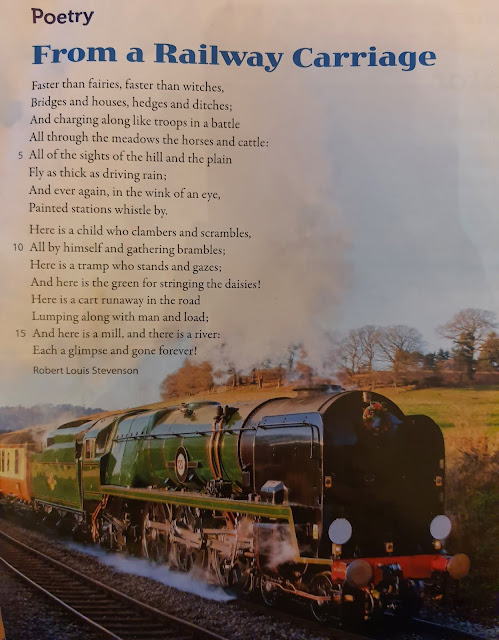
Comprehension: From a Railway Carriage (Wednesday; 23/6)

Image
K: Know why the similes and metaphors are used. U: Understand the interpretation of imageries. D: Recite the poem. Words of the Day 1. Imagery 2. Metaphor From a Railway Carriage Please refer to textbook page 146. Let's recite together! Task Time Please refer to textbook page 147.  Let's do Part A and Part B! You only need to type the part titles and your answers. Please answer the questions in your respective discussion room. 5 Autumnus 5 Hiems 5 Ver 5 Aestas

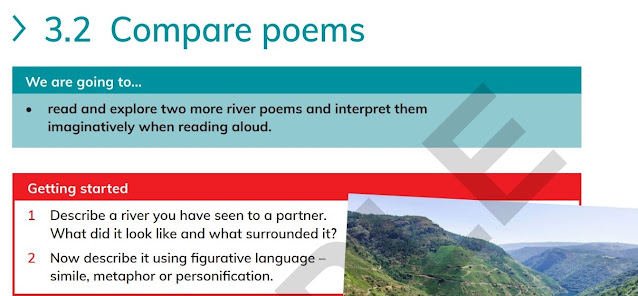
Grammar - 3.2 Compare Poems (Monday; 16/10) (Tuesday; 17/10) (Thursday; 19/10)

Image
K: Know the context of the poems. U: Understand the explicit meaning of the poems. D: Explore the figurative language inside the poems. Words of the Day 1. Imagery 2. Metaphor Let's begin Please refer to page 76-77 of your learner book.  Let's read the poem together and understand its content and structure! You have 10 minutes for this task. Task Time Please refer to pages 76 in your learner book.  Read the 2 poems and answer questions 1a to 1c in your Grammar book. For 1a to 1b, you need to answer for both poems. You have 30 minutes for this task.

Spelling Set 7 (Monday; 15/11)

Image
K: Know the Set 7 words and poem passage. U: Find and understand the definition of Set 7 words and poem passage. D: Create a sentence for each Set 7 words and a poem of our own in the style of the poem passage. Let's Begin! Task 1 Please listen to the words and poem carefully. For the poem part, make sure that each sentence is properly written in its correct position. For 6 Aestas, it is recommended to use a listening device while you do the quiz. Once done, you may proceed to the next task. Task 2 Please find and write the correct definition for each word. You are also needed to summarize the poem passage. The summary should be around 2-3 sentences. Write your word definition and poem summary in your Grammar book. For 6 Aestas, please do the same and submit your pictured/scanned work in the discussion room. Once done, you may proceed to the next task. Task 3 Please create a sentence for each Set 7 word. You are also needed to make a poem that follows the same style of the Set 7 p...

Grammar: Revision Part 1 (Tuesday; 2/3)

Image
K: Know the proper adverbs in a sentence. U: Understand the differences between similes and metaphors. D: Answer the adverbs, and similes and metaphors questions. Words of the Day 1. Adverb 2. Similes Without further ado, let's start! Adverbs An adverb is a word which gives information about a verb. Examples: How?  The students answered  politely. When?  She played the piano  today. Where?  The teachers are talking  downstairs. Task Time Please use your real name. If nickname, ensure your name is in a bracket. Attempt until you get 100%. Good luck! 5 Ver -  Click here! 5 Autumnus - Click here! 5 Hiems - Click here! 5 Aestas - Click here! Similes and Metaphors A simile compares two things using like or as. A metaphor compares two things by saying they are the same thing. Task Time Please use your real name. If nickname, ensure your name is in a bracket. Attempt until you get 100%. Good luck! 5 Ver - Click here! 5 Autumnus - Click here! 5 Hiems - Click h...